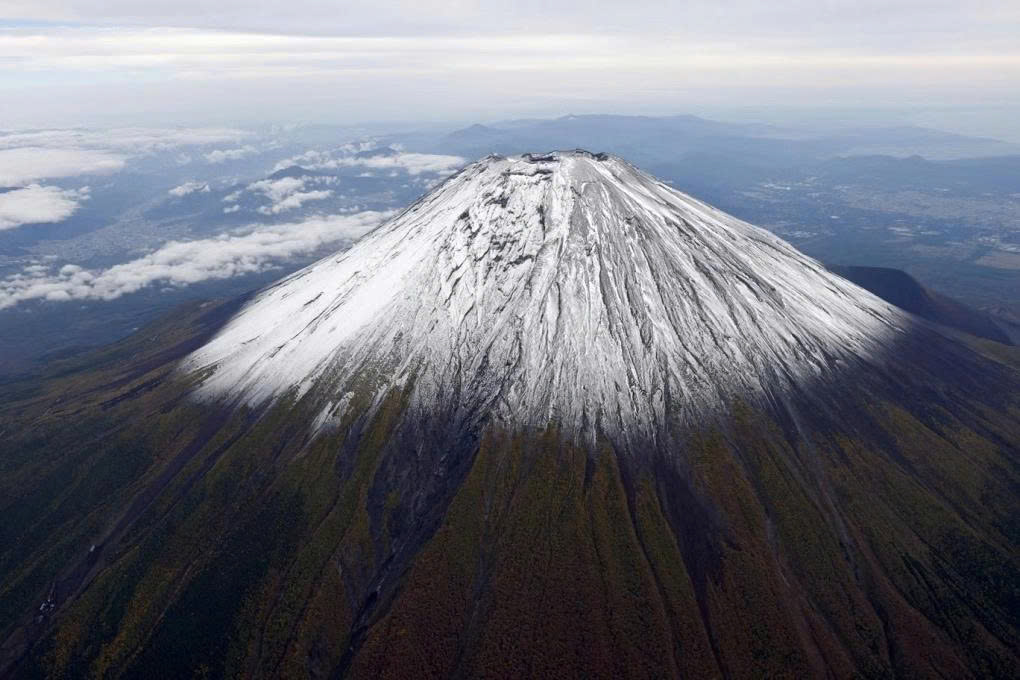
Mount Fuji, the majestic and spiritual symbol of Japan, finally received its first blanket of snow on October 17th, marking the official start of its winter season—a full 21 days later than the average historical date.
According to the Kofu Meteorological Agency, located approximately 40 kilometers from the summit, a thin layer of white could be observed from Kofu City, the capital of Yamanashi Prefecture, after temperatures near the peak dipped below $0^\circ\text{C}$ overnight.
This unusually late arrival, a significant delay compared to historical norms, directly reflects the record-breaking hot summer Japan experienced this year, as reported by the Asahi Shimbun daily. Following a tradition observed for over a century, the first snow on Mount Fuji is officially announced as soon as the initial layer of snow is visible from the Kofu weather station.
Mount Fuji typically sees its first snowfall in early October. While this year’s snow came later than usual, it was still earlier than last year’s exceptionally late debut on November 7th—the latest in the 130 years of recorded observation. Prior to that, the record for the latest first snow was October 26th, set in 1955 and matched in 2016.
Meteorologists and climate experts are pointing to this persistent delay as a stark indicator that climate change is visibly altering the seasonal patterns across Japan.

“The average temperature at the summit last year was record high, and the rainfall in October wasn’t sufficient to create snow. This is a direct manifestation of global warming,” noted one expert.
The prolonged high temperatures throughout the summer of 2024 subjected Japan to one of the most intense heatwaves in its history. The national average temperature soared $2.36^\circ\text{C}$ above the norm. Isesaki City in Gunma Prefecture recorded a scorching peak of $41.8^\circ\text{C}$ in early August. The Japan Meteorological Agency (JMA) documented at least 30 locations where temperatures exceeded $40^\circ\text{C}$ this summer, nearly doubling the previous record of 17 locations set in 2018. Tragically, over 100,000 people were hospitalized due to heatstroke.
Even in October, temperatures remained unusually high, with over 30 localities recording new seasonal highs. Kagoshima City, in southern Japan, hit $35^\circ\text{C}$, a rarely seen temperature for autumn.
Research indicates that the summer season in Japan has extended by about three weeks over the past four decades. This phenomenon is attributed to rising land and sea temperatures, combined with warm westerly winds and the influence of the Kuroshio current flowing along the eastern coast. While the length of winter has remained relatively constant, both spring and autumn are measurably shortening.
“We have broken temperature records three years in a row; this is a very alarming trend,” commented Professor Yoshihiro Iijima, specializing in climatology at Tokyo Metropolitan University, in an interview with DW. He expressed that he once believed temperatures would increase gradually over time, but the Earth is now witnessing an unusually abrupt and significant rise.
A study published last month further confirmed that the record-high temperatures in Japan during the summer of 2025 (note: original text says 2025, but context suggests 2024 or recent past) would have been “virtually impossible” without the impact of human-induced climate change. The report indicated that the rate of temperature increase in Japan is accelerating far beyond linear predictions, with three consecutive years from 2023 to 2025 recording the highest historical average summer temperatures.
According to experts, if this trend is not controlled, Japan could be left with only two distinct seasons within the next 30 years.
“This year, sea surface temperatures in both the Pacific Ocean and the Sea of Japan have increased sharply, making the air over land warmer and more humid than usual,” Professor Iijima explained.
Standing at $3,776$ meters, Mount Fuji is a deeply sacred destination in Japanese culture, attracting approximately 200,000 climbers annually, primarily during the peak season from July to September. Many visitors choose to stay overnight to witness the sunrise from the summit—a moment considered profoundly spiritual in Japanese tradition.
The summit is also home to a shrine dedicated to the goddess Konohanasakuya-hime, the Shinto guardian deity of Mount Fuji. For the Japanese people, the first snowfall is not merely a sign that winter is approaching; it is a profound marker intrinsically linked to the soul of the sacred mountain. The delayed snow serves as a poignant reminder that even the most enduring symbols of the nation are now susceptible to the undeniable forces of a changing global climate.
(According to Independent, Reuters)